14 August 2026, Johannesburg, South Africa: South Africa’s Constitutional Court has permanently halted Shell and Impact Africa’s controversial oil and gas exploration off the pristine Wild Coast. The landmark judgment handed down today, confirming the unlawfulness of their exploration right, is not only a victory for the Wild Coast communities who challenged fossil fuel giants, but is also an emphatic legal declaration that meaningful participation is not mere process and financial investments cannot override constitutional rights.
In the precedent-setting judgment handed down by Justice Jody Kollapen, the Constitutional Court upheld the finding in the 2022 judgment of the Makhanda High Court in the Eastern Cape which found that the exploration right granted to Impact Africa and Shell was unlawful due to serious deficiencies in the public participation process, amongst other concerns.
This judgment sets aside the Supreme Court of Appeal’s (SCA) suspension of the High Court order to allow Shell the opportunity to proceed with its third exploration right renewal application, which it had submitted unbeknownst to the communities. The SCA granted this suspension order even though it agreed that the right was unlawfully granted in the first place.
Instead, the Constitutional Court found that the SCA had misdirected itself in determining what constituted a just and equitable remedy where the right had been found to have been granted unlawfully, and that the deficiencies in the original exploration right could not be remedied after the fact, through a consultation process at the renewal stage.
The decision to grant the exploration right in the first place, and the subsequent two renewals, were set aside by the Constitutional Court. Impact Africa and Shell no longer hold any right to explore for oil and gas off the Wild Coast, the Court finding that, “Any other remedy would allow financial investment to outweigh grave constitutional violations and would signal that the rights of affected parties are subordinate to commercial interests. That is not what our Constitution envisages.” [para 151]
This judgment has been lauded by applicants, Wild Coast communities and environmental organisations who first brought an interdict against Shell in late 2021 following the discovery of the company’s plans to conduct seismic surveys based on a 2014 right granted by the Department of Mineral Resources and Energy. Following a successful High Court judgment in 2022, the case proceeded to the SCA on appeal by Shell, Impact Africa and the government.
Following the SCA judgment, the community and civil society organisations appealed the judgment to the Constitutional Court, which was heard in September 2025. Nearly a year later, the Court handed down a victorious judgment, vindicating the arguments of the communities, and affirming that their heritage, culture and livelihoods matter in decisions regarding the ocean.
In its judgment, the Constitutional Court says that in the context of extractive industries, “the enquiry cannot be reduced to a formal balancing exercise that treats cultural, religious, spiritual and environmental concerns as merely competing interests against economic development.”
“It is also ahistorical to place these interests on equal footing, given the long history of dispossession and marginalisation of coastal communities whose relationships with land and sea have often been subordinated to commercial extraction. Although job creation is a legitimate consideration, it cannot be assumed to be inherently beneficial without asking who receives those jobs, how secure they are and what social, ecological and cultural costs the affected communities are expected to bear. In this context, the communities’ constitutionally enshrined and protected rights are given practical force through procedural duties of meaningful consultation, participation and respect for their cultural and spiritual relationship with the environment. A just and equitable remedy should therefore not allow speculative or corporation-centred economic benefits to outweigh procedural justice where communities’ livelihoods, cultural identity and environmental interests are directly at stake.” [para 132]
Significantly, the Court made reference to the 2025 International Court of Justice Advisory Opinion (ICJ) on states’ obligations in the context of climate change, advising that governments have binding legal duties under international law to prevent climate harm, curb greenhouse gas emissions, and protect human rights from the existential threat of climate change. The Constitutional Court judgment states that, “decisions must be taken within a framework of heightened diligence, informed by scientific knowledge, international commitments and the foreseeable impacts of emissions on present and future generations.” [para 23]
This is the first time that the ICJAO on climate change has been referenced as a formal citation in a binding court judgment in Africa.
South Africa’s coastline is a hotbed for oil and gas exploration activities that will impact communities’ environments, their livelihoods, heritage and cultural practices. This judgment sets a critical precedent, impacting other oil and gas challenges already before the courts, as well as future exploration applications, and hopefully, the conduct of oil and gas companies seeking to exploit South Africa’s resources.
As the Constitutional Court judgment clearly states: “Protection of ecological systems is inseparable from the protection of rights to dignity, culture and livelihood.”
QUOTES
“If ants work together they can lift a log (African Proverb). Indlovu ibulawa imbovane (An elephant is killed by an ant). For centuries, colonialism and capitalism have enabled a system that ignores the rights of Indigenous People in their own land. At last we have been able to assert the rights of Indigenous People over the profits of global corporations.
This is a win not just for us as Indigenous People, but also for the environment and the planet. Having courts that listen to Environmental Defenders promotes wellbeing for all of us.
Unlike Shell, who went to court for their profiteering, we went to court for the future and for future generations. Our struggle is about the wellbeing of all including the children of Shell shareholders. It is about the sustainability of this planet.” – Sinegugu Zukulu, Director, Sustaining the Wild Coast
“I was sure we would win. Today, communities have to take the government to the court, again and again. This will continue as long as we have a government for the corporations and not for the people. But true development must come from the people. We as a People must determine our own future.” – Nonhle Mbutuma, Amadiba Crisis Committee
“Today’s judgment in the Constitutional Court is an important and historic victory not only for coastal communities, but for all South Africans who care about the environment, the rule of law, and the future of our children. Beyond the technical legal arguments, this case has always been about whether the interests and profits of multinational corporations override the rights of communities to effectively participate in decisions that will affect their livelihoods, their rights to a healthy environment, and their cultural and spiritual rights. The court affirmed that the right to public participation is not just about following a procedure and ticking boxes, but rather that it is about placing the dignity of our people at the centre of developmental decisions that will affect them.”– Delme Cupido, Hub Director at Natural Justice.
“The court was not looking at the profits that would be made from drilling the oil and gas in the ocean. Instead, it was focused on the environmental damage and the risks to the lives of people living along the coastline, because they are the ones who would bear the consequences of any harm caused. We applaud the Constitutional Court of South Africa for caring about the communities living along the Coast. We also thank the lawyers from Natural Justice, Ocean Hub, and the NGOs that have continuously supported and worked with the affected communities throughout this entire process since it began.
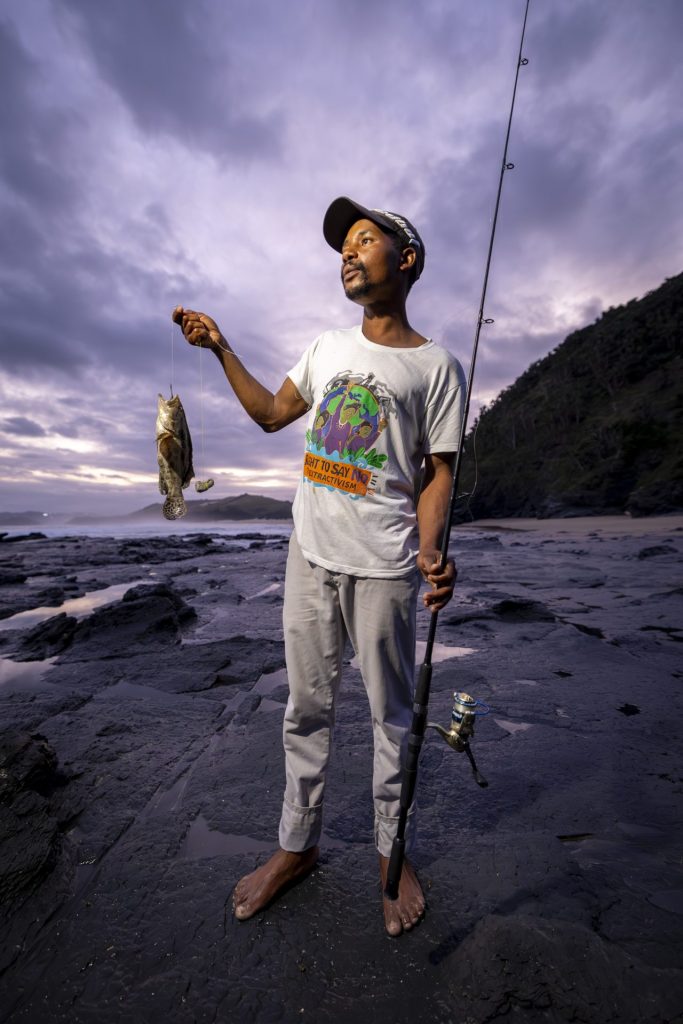
We, as communities, did not know that we had the power to challenge the government until we met and worked with them. Without their support, the oil and gas would probably have already been drilled in these oceans, because even some of our own leaders—the people we look to in the areas where we live—were turning against us and offering our oceans to companies, saying that the oil and gas should be drilled. But because of the unity between coastal communities and our legal representatives, that did not happen. We say: Amandla! Power to the rights of communities! Amandla!” – Sazise Maxwell Pekayo, Applicant and Kei Mouth fisher
“Today’s judgment makes me feel very happy and proud that the ocean is not for profit for mining companies. This tells us we are not alone in this fight. All our ancestors and lawyers, communities, journalists, organizations, and individuals are together in this long journey to protect our ocean and the rights of coastal villages. The connection that we have all together is amazing. Together, we do the best but alone we are less powerful.”
– Siyabonga Ndovela, Wild Coast fisher
“This judgment today confirms what communities in the Wild Coast and those all over the country have been saying for ages – no decisions about our land or resources can be made without us. Most notably, it held that the interests of multi-national corporations shall never trump the rights of the people. The SCA sought to give Shell a backdoor to ensure their investment was not wasted. The CC shut that door in favour of the coastal communities who argued that their spiritual, cultural, customary and environmental rights are too important to disregard. This is a resounding win, and we hope to take it forward to ensure that the right to public participation for impacted communities is seriously considered in all administrative matters.” – Kimal Harvey, the Legal Resources Centre
“Today we witnessed a groundbreaking victory at the Constitutional Court, the highest court in our land. The judgment is a victory for coastal communities, our constitutional democracy and the continued rigour of the judiciary and judicial processes. The Constitutional Court prefaced its judgment on the deep connection that coastal communities have with the ocean, for their livelihoods, their spirituality and their culture, and recognised that the protection of ecological systems is inseparable from the protection of the rights to dignity, culture and livelihood. This is also a very exciting judgment for global climate litigation- it is the first time an apex court in Africa has cited the ICJ advisory opinion on climate change in a binding judgment” – Melissa Groenink-Groves, Attorney and Programme Manager at Natural Justice
“Today the ocean, and the communities who are its custodians, prevailed over one of the world’s largest oil companies. The Court affirmed that our coast is a shared commons held for present and future generations – not raw material to be taken first and consulted about later – and it located this case within what it called a global reckoning with the climate crisis. It refused to let more than a billion rand buy a way around the Constitution. In the words the Court itself borrowed for those who ride roughshod over the rights of others – uzenzile akakhalelwa: self-inflicted harm deserves no sympathy. This is a victory for people, for dignity, and for a living coastline.” – Ricky Stone, Cullinan and Associates Inc.
“The Constitutional Court’s judgment safeguards fundamental human rights in the face of determined efforts by multinationals to deepen society’s reliance on fossil fuels despite what the International Court of Justice characterised as “an existential problem of planetary proportions that imperils all forms of life and the very health of our planet”. It is a victory for the rule of law and vindicates years of courageous opposition by Wild Coast communities and environmentalists.” – Cormac Cullinan, Cullinan and Associates Inc.
“The 14 August 2026 will go down as a historic day following this landmark judgment by the Constitutional Court. This ruling vindicates the affected grassroots communities of the Wild Coast, civil society organisations, and our legal representatives who fought tirelessly together.
The apex court firmly rejected Shell’s assertion – supported by the SCA – that the fundamental requirement for meaningful public participation could be applied retrospectively via the backdoor to cure a fatal illegality. While the minority judgment considered the multi-million dollar corporate investment, the majority correctly recognized that legitimizing such an illegality would undermine our Constitution. The message from the Constitutional Court today is clear: people and their constitutional rights come before corporate profits.” – Eugene Perumal, Governance and Legal Advisor, Greenpeace Africa