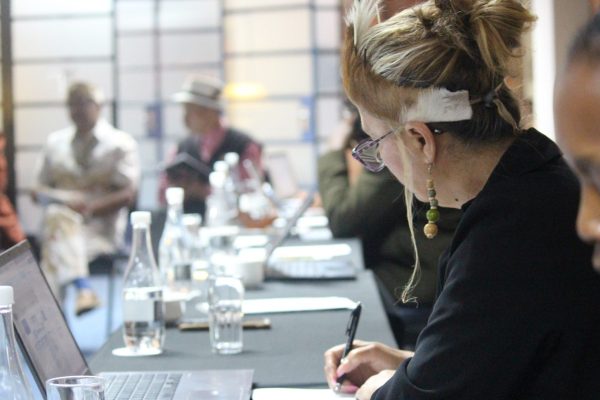

The Natural Justice team and a number of its partners from Kenya, South Africa and Namibia attended a one week Certificate Program in Local and Indigenous Knowledge for Community-Driven Development in Techiman, Ghana from 24-30 June, 2012. Coordinated by the Center for Indigenous Knowledge and Organisational Development (CIKOD) in collaboration with the University of Cape Coast and Water Aid in Ghana, the course introduced the concept of “endogenous development”, an approach to social and economic justice that involves strength-based development “from within” ensuring initiatives are community-driven and based on strengths that contribute to their own socio-cultural, economic and political development.
The course began with an introduction to endogenous development, perspectives on indigenous sciences, the local knowledge of each participant and expectations of the course. Participants visited the nearby Forikrom community where they were introduced to the traditional chiefs and elders, traditional foods made by the community, the sacred sites and surrounding ancestral caves, and local eco-farming. Members of the community presented on successful endogenous development processes utilised by the community, including the work of Traditional Authorities and HIV/AIDS, interfaces between traditional and modern medicines, and the Forikrom Eco-cultural Tourism project.
Throughout the week, endogenous development tools such as Community Institutional Resource Mapping (CIRM) and Community-Driven Health Impact Assessment Tool (CHIAT) were discussed. Participants were immersed in local examples of projects involving endogenous development processes and tools including the water, sanitation and hygiene project, the Traditional Authorities Transparency and Accountability Charter, and the Rural Women Farmers Association of Ghana. Representatives from Natural Justice, Save Lamu, Kivulini Trust, Karamacan and Kukula Traditional Healers also presented on biocultural community protocols as tools for the legal empowerment of communities.
The one-week course was a rich and engaging opportunity to explore and deepen knowledge of endogenous development processes. Natural Justice looks forward to continuing the implementation of endogenous development processes in its work with communities. Natural Justice and other participants thank CIKOD, the University of Cape Coast and Water Aid for hosting the course, together with the ABS Capacity Development Initiative, the Open Society for Southern Africa, the Heinrich Böll Foundation, the Christensen Fund, and University of Cape Town’s Open AIR project, for their generous support.